Blog

Tail of Horse

I follow my translator’s recommendations in all matters. He says drink teas of pelo de elote (hair of corn) and cola de caballo (tail of horse.) This is for my kidney infection, which, it appears has grown worse and invaded other areas. Possibly the hippocampus, where trauma is often recorded and rarely forgotten.

Translating what? you may ask. My first novel, Playing for Pancho Villa, from English to Spanish, now with the transfixing title: El Pianista de Pancho Villa.

I know. I have asked myself the same question. If English was good enough for Jesus Christ, why not leave the book alone? Continue reading “Tail of Horse”

Love Patch

If you look closely, you can see a patch of hair under my lower lip. I was going to glue some sort of fuzz there but decided it was just as easy to grow a little of the real thing for the purpose of tonight’s reading. You see, I find myself in the middle of a crisis. Not global climate disturbance. Not unaffordable housing, medical care, college tuition—our oceans choking on plastic. The spread of fascism. No, it has to do with the way I look. Specifically, my face. And whether to grow and keep a soul patch—also known as a jazz patch, mouche, jazz dot, and love patch. Continue reading “Love Patch”

Violation

As a man, and regarding rape and Dr Ford, I know one tiny fraction of what it’s like. I am 81 now. I was in my early forties or younger when it happened. I was a strong man and agile. I was canoeing down the Petaluma River in California with two or three of my students. They were older, thirties maybe. At least one was a woman. We had eaten a snack on shore. Out of the blue one or more held me down and the others tried to pull my swim shorts down and off. I fought back and threw them off. But the point is I felt the most horrified and panicked violation while it was happening, and I know it was a small event compared to what so many women have experienced. I have never spoken publicly about this. Why would I? There’s some sort of shame attached to it that I don’t understand. But this is a good occasion to bring it up. If I could sit in front of the old white (all) men senators, I would say, “You don’t know what you’re talking about. You have no idea what this is about and are unqualified to make any decision to seat this man for a lifetime appointment. You are criminally uninformed. And we will vote you out.”

Anthony Bourdain’s “Fields Notes on Mexico,” 10 January, 2018. In His Memory

“Americans love Mexican food. We consume nachos, tacos, burritos, tortas, enchiladas, tamales and anything resembling Mexican in enormous quantities. We love Mexican beverages, happily knocking back huge amounts of tequila, mezcal, and Mexican beer every year. We love Mexican people—we sure employ a lot of them. Despite our ridiculously hypocritical attitudes towards immigration, we demand that Mexicans cook a large percentage of the food we eat, grow the ingredients we need to make that food, clean our houses, mow our lawns, wash our dishes, and look after our children. As any chef will tell you, our entire service economy—the restaurant business as we know it—in most American cities, would collapse overnight without Mexican workers. Some, of course, like to claim that Mexicans are “stealing American jobs.” But in two decades as a chef and employer, I never had ONE American kid walk in my door and apply for a dish washing job, a porter’s position—or even a job as a prep cook. Mexicans do much of the work in this country that Americans, probably, simply won’t do. Continue reading “Anthony Bourdain’s “Fields Notes on Mexico,” 10 January, 2018. In His Memory”

Toledo and Faces of the Spanish Civil War

While in Toledo, Spain, I rushed to  the Museo del Ejercito, the Museum of the Army. I had barely a half hour. As I went, I asked attendants where I could find things having to do with the period 1936 – 1939. The Spanish Civil War. “There’s very little,” said one woman. I watched carefully to see whether she was also expressing an opinion one way or another as to whether that was a good or bad thing. Eight or ten years ago, I went through the Catalonia Museum in Barcelona., again looking for the civil war. There was one small room with a few photos on two walls. People in that museum’s book store told me they had very little written on the war; and that it depended on who was in power when it came to choosing a version of history. If any at all. Continue reading “Toledo and Faces of the Spanish Civil War”
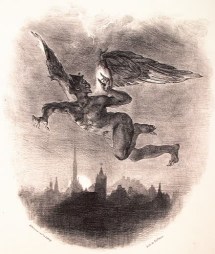
A Letter from Mephistopheles to His Mother, the Snake

Last night, precisely at the hour that the cucarachas in my house rose from their daylong slumber, I wrote a poem for you, Mother, celebrating my origin, when I slipped past your scaly loins and gave my first half-throttled scream. In spite of what others say, my skin was tender and the edges of your eggs, ragged and unforgiving. I cannot tell you how long it took me to unwind and find my tail. To see it quivering with new strife. I, your young Fliegengott, God of Flies, charged by you to bring war and darkness to all of life. An honest offering, when compared to the promises of the Bearded Fellow in the sky, whose plans you say I am tasked to disrupt. I, Lord of Rats, patron saint of the Long Tails of New York, Southern District, who pressure me with their Rule of Raw and the Triumph of Tooth during this Age of Lies. To whom I respond, Wouldn’t it be too bad if I asked you, my Mother, to drop down into the electric soot beneath Time Square and make lumpy digestive juices of them all. I have tried to tell them they are mistaking me for someone else. That it is not I whose squinty sun rises puffed and orange over Manhattan each morning, breathing in its own self-delighting smells. That we and they and the Old Man in the Sky are the only ones who stand between this bloated Faust and the sweet fifteen-year-old’s of our democracy. And so, Mother, I ask you to hold your snout and approach this high-rise, stale, bedpan stink and enter that chamber where humans purport to think, and swallow his dark pulp, make it your own, so that the status antequam can return to when it was mainly you and I and the Man in the Sky who determined the outcome of the struggle between good and evil, and not this amateur who would supplant us all. Therefore, let us ally ourselves with the Long Tails of the Southern District and, after you have supped, let them finish off what is left in the cup.

Much Love,

from Him who aims to please,

Your Devoted son,

Young Count Mephistopheles.

Where I Confess to Being Mephistopheles

(Take a meditation pose)

Excuse me,

You’ve caught me at the hour of my meditation,

the moment my mantra and I meet each other

halfway.

Diese schwankenden Gestalten

These swaying forms that approach me.

Continue reading “Where I Confess to Being Mephistopheles”

Review of Annie Smith’s “Fragments of Loss” (Amazon.com)

I am not used to writing about people who are actually dying. I kill people off in my novels. But it’s fiction, written with the assumption that the book and I will continue. But this important and wonderful book, Fragments of Loss by Annie Smith, written in lovely, clean free verse, is about someone dying who really dies. Her husband Jack. It is a different kind of writing. It makes my fiction writing seem suspect, slightly disingenuous and make-believe. Her book is about the real thing. Something that will happen to me—and to you. It’s an event I have been pushing back down into my unconscious my whole life. Into the drawer labeled Denial. I suppose I do it through my writing, as well. Maybe that’s one of the functions of writing, of art and creativity in general. Perhaps along with everything else we do. To not fully consider the reality of one’s coming end. To not include it in the list when we look forward into the future. Continue reading “Review of Annie Smith’s “Fragments of Loss” (Amazon.com)”

A Huevo

Only a fool would choose the desert entrance to Real de Catorce, when they could take the 2-kilometer long wormhole through the bedrock instead. I’m talking about the one-lane tunnel that was unlit on a recent weekday, when even cell phones weren’t working. Events triggered, according to superstitious locals, by up-coming tectonic clashes or political upheavals. Or both.

And so now you had to take the baton from the man at the entrance. And if, God willing, you came out the other out the other side, as most people did, you handed the baton to someone else. A rational system, and democratic like the tope, where even the President of the Republic has to observe the laws of physics. If not necessarily any others.

The Governor of an unspecified state arrived on that Wednesday. The poorly paid tunnel attendant greeted the first car, a bodyguard with a bull neck and expensive dark glasses, and explained that the tunnel was in use and, after that, it was the other side’s turn to come through. The bodyguard checked with the Governor, a man of ample girth, who was hungry and had been looking forward to a long meal at the little Swiss-run hotel at the other end of the tunnel, renowned for its thick steaks and fine wines. And afterwards, to a nap in the usual charming, top-floor bedroom along with his adoring, young, light-skinned secretary.

“Aren’t I the Governor,” he asked. And gave the signal to proceed.

His security men were Mexican ex-Marines, but not all-knowing. Because, with about the same frequency, the odd narco warlord also liked to eat thick steaks in the little Swiss-run hotel—and to wash them down with 100-Euro Spanish Riojas, which he brought along in his black Ford Expedition—while his bodyguards, in their SUVs, carried equally generous supplies of lightly greased 7.62 x 39 mm rounds for their Chinese-made AK47s.

The difference was that the Governor, though married, was hungry and in love, and “Chuy,” our narco warlord of the Soft Waist, was already full of steak and premium Rioja and drowsy with satisfaction—when the lead car of each party spotted approaching headlights and had to come to a stop. The guards got out. The Governor ordered that the citizens blocking his way should reverse direction and clear the tunnel. And so his Marines, holding all kinds of automatic and semi-automatic weapons, approached Chuy’s group. While the latter’s sicarios kept their AK-47s out of sight, so as not to alarm any citizens who might run out the other end and phone the Army which would then happily descend on the Chuy from both the East and West with their nopal-green HumVees and mounted Browning heavy machineguns that fired .50 rounds as long as your hand.

In the meantime, the poorly paid attendant on the Swiss hotel side, who had stood back as Chuy’s group entered the tunnel, decided to seek invisibility among his goats higher on the inner canyon wall. And so he was not present when the Butane truck from the Sonigas rumbled up to the tunnel. Its driver—the father of four hungry children under the age of ten—was eager to get out of Real de Catorce and away from the pinche tourists and their fat wallets. With no one to warn him otherwise, he entered the tunnel, and used his powerful headlights to fill the darkness with Butane-generated brightness.

By that time, the gunmen from both caravans were brandishing their weapons, and the Governor and Chuy, from behind their over-sized SUVs, were screaming obscenities at each other, forgetting that they had cooperated with each other over the last three years and belonged to the same moño-waitressed country club. Their respective lieutenants begged for calm. A significant current of mountain air was sucking through from the Swiss hotel side, they said, and would serve as God’s own bellows, if their military-grade bullets hit any of the eight, nearly full gas tanks and ignited the white fire that would cook them to termino medio in the singe of an eyelash.

That was when word spread that a Butane truck had pulled up behind Chuy—upwind from all of them, with enough explosive power to blow them all out the Governor’s end of the the tunnel, along with their SUVs and what remained of Chuy’s 100-Euro Riojas and the Governor’s unfulfilled condoms, Sico brand, Ultra Sensitive, “designed to let you feel the warmth of your partner,” in a bursting grand finale to the sound of a soprano’s wavering high C and an impressive short-lived roaring between the ears.

Chuy had just screamed something like “A huevo y, si no, a balazos!”

Which was something like “You’ll back the fuck up, or I’ll blow your heads off!” Only stronger. A getting-to-yes formula perfected during the Mexican Revolution—just as he began to understand what the Butane truck meant, and remembered that he had the Governor’s number under Contacts on his new iPhone. Which he smashed against the tunnel floor, when it didn’t work under the one thousand meters of peña above him. Instead, in the light of his headlights, and though his hands shook and affected both his syntax and spelling, he scribbled a note to the Governor—in which he apologized for being a pendejo. And ordered the bodyguard he trusted the least to deliver it, hoping some good might come of the attempted negotiation. But that man returned without bullet holes in him, and delivered the reply, in which the Governor also apologized and said they should have drinks at the Country Club and discuss what they could do to make sure that Andrés Manuel López Obrador, that corrupt Communist shit, didn’t win the Presidential election in July and legalize drugs and grant a general amnesty to narcos everywhere.

Whereupon, both parties switched their assault weapons onto Safety and slowly backed out of the tunnel the way they had come in, bashing fenders as they went. A fifteen-minute operation, with headlight blinding everyone. Twenty minutes for Chuy’s group, because the Butane truck driver was nervous—given the extra dimensions of his truck—and because one of Chuy’s men, the one with half an ear missing, sat too close to him, holding a 9mm Beretta automatic up against his own perfectly in tact right ear.

Once outside, the Governor, his jowls sagging with resentment, repaired with his secretary to a modern, characterless Motel with a poolside bar on the main trucking route in Matehuala.

And Chuy, in a better mood than before, descended the lovely dirt road to the West, where it is said you can buy peyote buttons for meditative experiences and where small inns with nothing to offer still managed to get fruit to grow to maturity in clear glass wine bottles affixed to the pear trees that grow there in quiet courtyards. And where Chuy could linger a while, sip a lukewarm Coke by himself and breathe in the smoky scents of the Potosí desert and dream of the young, dark-skin beauty he would marry someday—and make as happy as he could.

My Goats and Andreas Scholl, Countertenor

Am I sitting in this table-wobble Bohemia café in a colonial Mexican town recognized as a UNESCO Heritage Site, embarking on the one sentence I am allowed for the evening, as I listen to Andreas Scholl sing Bach cantatas in his countertenor voice, which sounds like a castrato but isn’t, yet prompting my friend, a retired, down-to-earth officer of the British Royal Navy, to make silly, limp-wristed gestures with martyred, up-turned eyes as if appealing to God to join him in rejecting the whole idea of this kind of music, while of course the whole time the real target of his ridicule, his gentle jab, is someone close to me, if not identical, the one who loves listening to Andreas Scholl, about whom I know nothing at all, except that he has a long and distinguished career in the Music World and is surely one of the most talented in his field, again about which I know very little, except for once in an ancient abbey, Maguelone, on the French Coast near Montpelier when a another friend and I—he had painted the abbey many times in wonderful studies of light and dark, as if the building, surrounded by Maritime Pines were a ship of lesser tonnage, not English, approaching through a thinning fog, backlit by a weak sun that had forgotten that it was a Mediterranean sun—were sitting, he and I, in the middle of the empty pews, when a similar voice, carried on perfect acoustics, filled the abbey for several minutes, followed by a silence during which I waited for the mezzo-soprano to emerge from somewhere above and behind the altar, which happened, but as one of three young men—not a woman—grinning at their daring contribution as they passed by, and we, marveling, smiled right back at them, enchanted that a male voice could sound like that, in an abbey surrounded by dark Maritime Pines that had survived Roman shipbuilders—I’m talking about masts—all of which made me wonder whether the Roman soldiers, sitting around their campfires, wiping thick, heathen blood off their broadswords, had asked their own castrato or falsetto warrior to get up and sing a tune to relax his exhausted comrades, whose eyes would have been a mixture of Germanic Blue and Mediterranean Brown, or Cow-Eyed Limpid Umber—Homer’s phrase—if they were of Greek descent, and who didn’t think for a second of their singers as menso, zafado, loco, missing a wooden screw, or as someone whose goats had gone to the mountains, hence Mexican for wacky, but just singing with vocal cords designed differently from yours and mine, hence completely undeserving of ridicule of any kind, least of all by me toward myself for going on like this without the usual punctuation, since Andreas Scholl, surely not dressed in a leather Roman battle skirt, has been stringing me along, as well as allowing me to make whatever I wanted to of his voice and of the mystery surrounding it, as well as of these Maritime Pines (gesture) made into tall masts, ghosting toward me, approaching off the coast of Montpelier, carrying a delegation of people I wouldn’t know but who are mezzo-sopranos and Hermaphrodites who can sing like Andreas Scholl and have been hoping for some time to find a writer wanting to write to their cantatas, which also go on and on, as their voices caress first the abbeys, then the Pines, and finally the mountains where my goats have gone when I listen to this music, which, as far I’m concerned, I wish would never end.